
How to Craft a Winning Content Strategy for Sustainable Brand Growth
A practical 7-step guide to building a content strategy that grows your brand.

A winning content strategy for sustainable brand growth starts with a clear goal and a defined audience. Add a distinct brand voice, a few focused content pillars, a realistic publishing rhythm, and simple metrics you review on a schedule. You can build it in seven steps: set goals, know your audience, define your brand, choose pillars, pick formats and channels, plan a calendar, and measure and refine.
Most brands don't struggle with content because they lack ideas. They struggle because the ideas don't connect. One week it's a product post, the next it's a trend, and nobody can say how any of it supports the business. A content strategy fixes that. Here's how to build one, keep it going, and tell whether it's working.
What is a content strategy?
A content strategy is a written plan for what you'll publish, who it's for, where it will live, and how it supports your business goals. It turns content from a series of one-off posts into a system that builds trust over time.
A good strategy answers five questions:
- Why are we creating content? (The goal.)
- Who is it for? (The audience.)
- What will we say? (The message and pillars.)
- Where will it appear? (The formats and channels.)
- How will we know it worked? (The metrics.)
A strategy is different from a content calendar. The calendar says when you'll publish. The strategy says why, and it comes first.
It's also a living document. Many teams find that refining the plan does more for results than simply publishing more often. A clear strategy gives you something specific to improve.
What makes brand growth "sustainable"?
Sustainable brand growth comes from compounding trust and recognition, not short bursts of attention. Content supports it when people can recognize you, believe you, and come back, month after month.
A viral post can lift your numbers for a day. Sustainable growth comes from:
- Consistency. Your look, tone, and message feel like the same brand everywhere.
- Usefulness. Your content solves a real problem for your audience, so they return.
- Compounding assets. Guides, videos, and resources keep working long after you publish them.
- A realistic pace. You can keep it up for a year, not just a launch month.
How do you build a content strategy, step by step?
Work through seven steps in order: set goals, research your audience, define your brand, choose content pillars, select formats and channels, build a calendar, and set up measurement. Each step narrows the next.
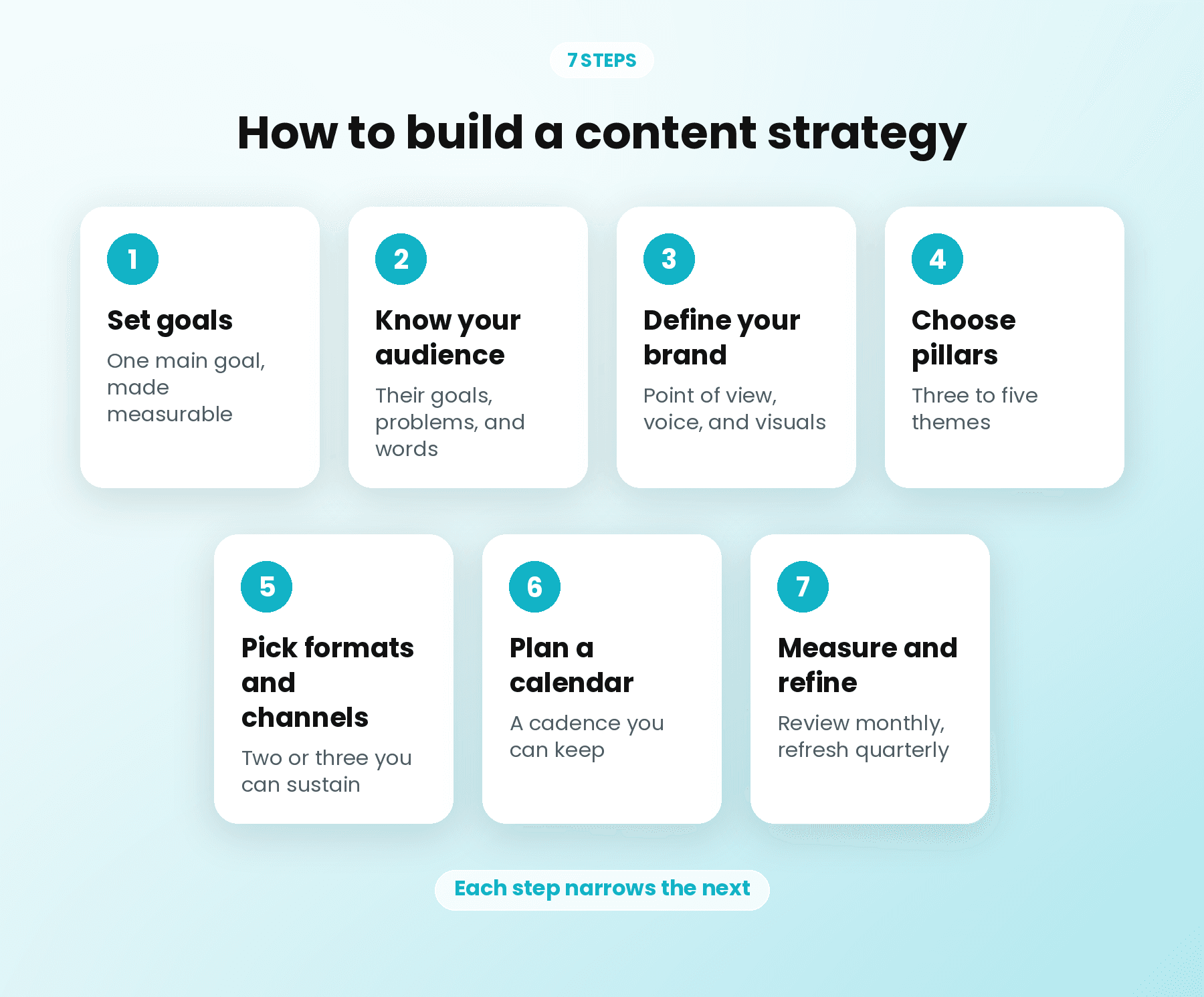
Step 1: What do you want content to achieve?
Start with one primary business goal. It might be awareness for a new brand, qualified leads, customer retention, or authority in a niche. Pick one main goal and, at most, one supporting goal. If everything is a priority, nothing is.
Then make it measurable. "Grow our audience" is vague. "Build an email list of people who want our weekly tips" is something you can track.
Step 2: Who are you creating for?
Describe your ideal audience in plain language: who they are, what they're trying to do, what slows them down, and what they search for or ask about. A one-page summary based on real conversations is enough.
Good sources include customer emails, reviews, support questions, sales call notes, social comments, and search suggestions.
Pay attention to the language your audience uses. Using their words in your content helps you connect, and it helps search engines and AI assistants match your content to their questions.
Step 3: What does your brand stand for?
Your content needs a recognizable identity. Define three things:
- Your point of view. What do you believe that others in your space might not say?
- Your voice. Is it warm, expert, playful, or direct? Write down three words and one thing your voice never does.
- Your visual identity. Your logo, colors, typography, and image style, used the same way everywhere.
Small teams often slip on the third. When each asset is made in a different tool by a different person, the brand drifts. A saved brand kit that's applied to everything you create fixes that at the source.
Step 4: Which content pillars will you build on?
Content pillars are the three to five themes you return to again and again. They keep you focused and give your audience a reason to expect something from you.
A simple way to choose them is to find the overlap of three circles:
- What your audience cares about
- What you know better than most
- What supports your business goal
For example, a neighborhood café might choose four pillars: behind the scenes, coffee and baking tips, community stories, and seasonal specials. Every post fits one of the four. Anything that doesn't fit is a candidate to skip.
Step 5: Which formats and channels fit?
Choose formats your audience likes and your team can produce well, then focus on the channels where those people spend their time.
| Format | Works well for | Typical role |
|---|---|---|
| Long-form articles and guides | Search visibility and detailed questions | Builds lasting traffic and authority |
| Short video | Reach, personality, and product demos | Gets you discovered and remembered |
| Social images and carousels | Quick tips, announcements, and community | Keeps you visible between bigger pieces |
| Email newsletters | Direct relationships | Turns readers into returning customers |
| Slide decks and presentations | Explaining ideas, sales, and training | Supports sales and thought leadership |
| Audio and voiceover | Narrated videos, podcasts, and accessibility | Adds depth and a human voice |
Start with two or three formats you can produce consistently. Adding a channel is easy. Keeping it healthy is hard.
Step 6: How do you plan a calendar you can keep?
A calendar turns your strategy into action. Keep it simple:
- Set a cadence you can sustain. One strong piece a week beats five rushed ones.
- Plan in themes. Give each month a focus tied to a pillar.
- Build in repurposing. Plan each big idea to become several smaller pieces from the start.
- Assign owners and deadlines. A plan without owners is a wish list.
Step 7: How will you measure and refine it?
Pick a few metrics tied to your goal, check them on a fixed schedule (monthly works for most teams), and let the results decide what you do more or less of. The measurement section below covers this in detail.
How do you make one idea work across formats?
Start with one core idea, then adapt it to each format. This is repurposing, and it's one of the most efficient ways to keep content consistent.
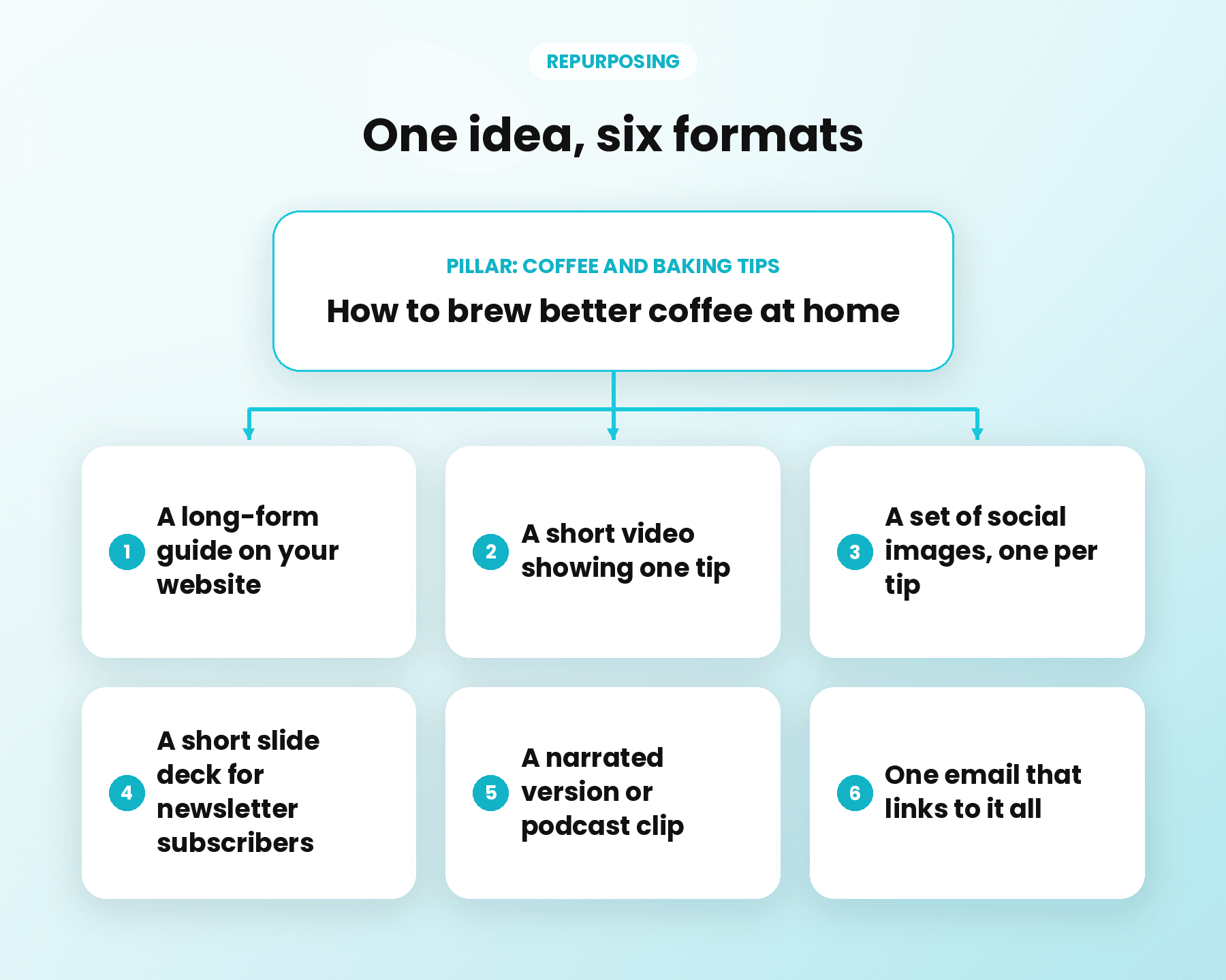
Say your pillar is "coffee and baking tips" and the idea is "how to brew better coffee at home." One idea can become:
- A long-form guide on your website
- A short video showing one tip
- A set of social images, one per tip
- A short slide deck to share with newsletter subscribers
- A narrated version for your video or a podcast clip
- A single email that links to all of the above
You do the thinking once and use it six times. Reshape it for each channel rather than pasting the same text everywhere. When the guide, video, and images all look and sound like one brand, people remember you faster.
How do you measure whether your content strategy is working?
Choose metrics that match your goal, track them monthly, and look at trends rather than single posts. Pair a reach metric with an outcome metric so you can tell attention from impact.
Different goals call for different numbers:
| Goal | Useful metrics to track |
|---|---|
| Awareness | Reach, impressions, branded search, and follower growth |
| Engagement | Saves, shares, comments, time on page, and video completion |
| Leads | Email sign-ups, form submissions, and enquiry requests |
| Retention | Repeat visits, newsletter opens and clicks, and repeat purchases |
| Authority | Mentions, backlinks, and invitations to speak or collaborate |
Measurement is where many strategies quietly fall apart, usually because nobody agreed on what "working" means. Decide that up front, and the monthly review becomes simple:
- List your top and bottom performers by the metric tied to your goal.
- Look for patterns in topic, format, and length.
- Decide: do more of one thing, less of another, and test one new idea.
Review the whole strategy every quarter. Audiences change, and your pillars may need a refresh.
What are the most common content strategy mistakes?
The most common mistakes are having no defined audience, chasing every trend, spreading across too many channels, using inconsistent branding, and never reviewing results.
- No defined audience. "Everyone" is not an audience.
- Chasing every trend. Trends are fine when they fit your pillars. Otherwise, they dilute your brand.
- Too many channels at once. Do a few well before adding more.
- Inconsistent branding. Different colors, fonts, and tones erode recognition.
- Skipping measurement. If you never look back, you can't improve.
Where Designs.ai fits
A strategy is only as good as your ability to carry it out every week. Designs.ai helps with steps 5 to 7, the making and adapting, so you can spend more time on the thinking in steps 1 to 4. In Agents Mode, you describe a goal in plain language, and specialist agents help create images, storyboards, videos, slides, and audio, with your Brand Kit applied so every format looks like the same brand.
For example, you could brief it like this:
"Our brand is a neighborhood café. This month's pillar is 'coffee and baking tips' for local customers on Instagram. Create four square social images with one tip each, a short video storyboard on how to brew better coffee at home, and a short slide deck for our newsletter subscribers. Use our brand kit."
Tools can't choose your goals or your audience for you. They can help you turn a clear strategy into consistent, on-brand work, week after week.
Frequently asked questions
What is a content strategy?
A content strategy is a plan for what content you'll create, who it's for, where you'll publish it, and how you'll measure results. It links your content to your business goals so every piece has a purpose.
What are the main steps to build a content strategy?
Set a clear goal, research your audience, define your brand voice and visual identity, choose three to five content pillars, pick formats and channels, plan a realistic calendar, and measure results on a regular schedule.
How many content pillars should a brand have?
Most brands do well with three to five content pillars. Fewer can feel repetitive, and more can spread a small team too thin. Choose themes where your audience's interests, your expertise, and your business goals overlap.
How long does it take for a content strategy to show results?
It varies by goal, channel, and industry. Social content can get a response quickly, while search-driven content tends to build over months. Review your metrics monthly and your strategy quarterly, and judge progress by the trend rather than a single post.
How do I keep my content on brand across formats?
Define your voice and visual identity once, write them down, and apply them to every format. Saving your logo, colors, and fonts in a brand kit, and reviewing each piece against a short checklist, keeps images, videos, slides, and audio consistent.
Can AI help with a content strategy?
AI can speed up drafting, design, and repetitive tasks. It works best when you've already decided your goals, audience, and message. Think of it as a tool that helps you carry out your strategy, not a replacement for one.