
How to Summarize Articles with AI: A Practical Guide for Content Teams
Summarize and analyze articles with AI: prompts, uses, and limits to know.

To summarize an article with AI, give a large language model (LLM) the full text, tell it who the summary is for and what you need from it, and ask for a set format with the key points tied back to the source. Then check the summary against the original. AI makes reading and analysis much faster, but a person still verifies the facts and decides what matters.
Content teams read a lot: industry articles, reports, customer research, webinar transcripts, and their own back catalogue. Summarizing all of it by hand is slow, and skimming means missing things. AI summarizers help you get the gist quickly and pull out what's useful. This guide covers what a good summary includes, a step-by-step process, prompts you can reuse, practical uses for marketers, how to move from summary to analysis, and the limits to keep in mind.
What should a good article summary include?
A good summary states the main point first, captures the key supporting points, keeps the author's meaning, and is shaped for the person who will read it.
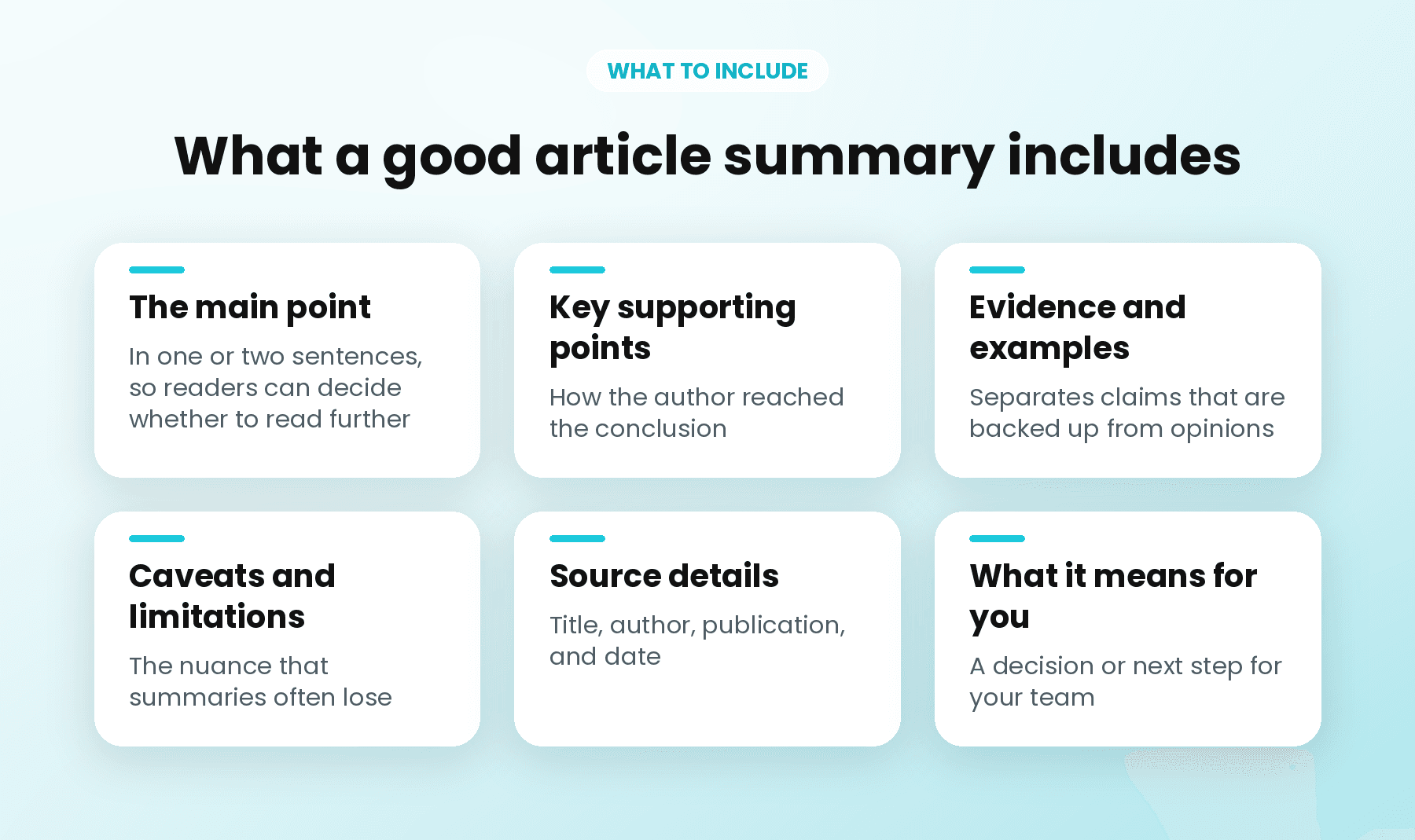
| Element | Why it matters |
|---|---|
| The main point in one or two sentences | Lets the reader decide quickly whether to read further |
| Key supporting points | Shows how the author reached the conclusion |
| Evidence and examples | Separates claims that are backed up from opinions |
| Caveats and limitations | Keeps nuance that summaries often lose |
| Source details | Title, author, publication, and date, so anyone can check the original |
| What it means for you | Turns reading into a decision or next step |
The last row is where an AI summary becomes useful for your team rather than just shorter.
How do you summarize an article with AI, step by step?
Give the model the full text, a clear purpose, and a fixed format, then verify the result against the source.
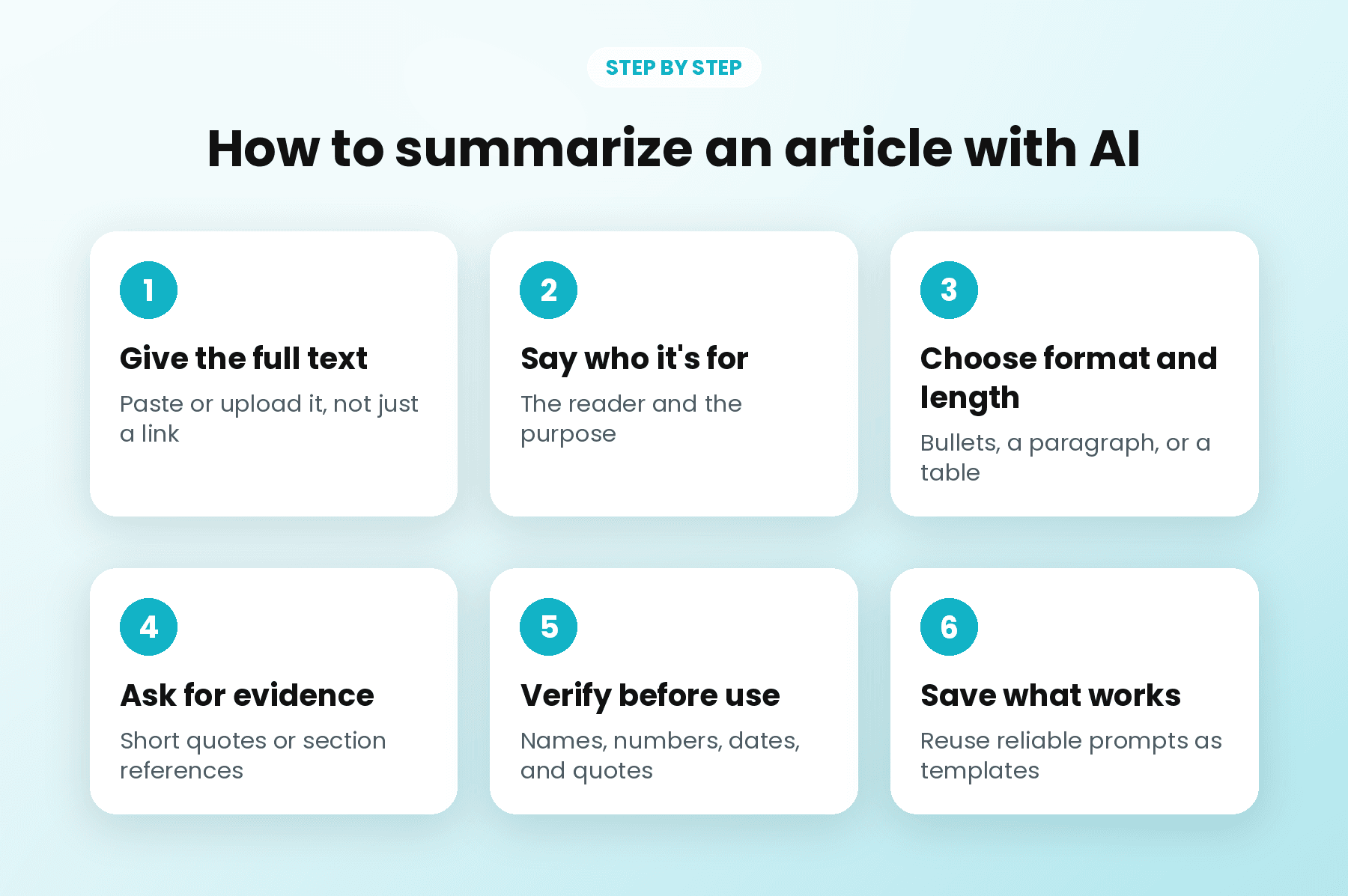
Step 1: Give the model the full text
Paste the article or upload the file rather than relying on a link alone. Some tools can't open every page, especially those behind paywalls or logins, and may summarize from a partial view or from memory without telling you. Only share content you're allowed to use, and remove confidential or personal details first.
Step 2: Say who the summary is for
A summary for your CEO looks different from one for a copywriter. Tell the model the reader and the purpose, such as "for a social media manager planning next month's posts."
Step 3: Choose the format and length
Ask for a specific shape: five bullet points, a 100-word paragraph, a table, or a one-line takeaway plus three supporting points. Fixed formats make summaries easier to compare.
Step 4: Ask for evidence tied to the text
Ask the model to include short quotes or section references for each key point. This makes checking much faster and discourages the model from filling gaps with guesses.
Step 5: Verify before you use it
Read the original, or at least the parts behind each key point. Check names, numbers, dates, and anything you plan to repeat publicly.
Step 6: Save what works
When a prompt gives you a reliable summary, save it as a template so everyone on the team gets consistent results.
What prompts work best for summarizing articles?
The best prompts state the reader, the purpose, the format, and the rules for accuracy.
Here are prompts you can copy and adapt:
Quick summary
"Summarize the article below for a busy marketing manager. Start with the main point in one sentence, then give five bullet points with the key supporting details. Use only information from the article. If something is unclear, say so instead of guessing."
Summary with evidence
"List the article's three to five main claims. For each claim, include a short direct quote from the article that supports it, and note whether the claim is backed by evidence or presented as opinion."
Content brief
"Using this article as background research, draft a content brief for a blog post aimed at small business owners. Include the core question readers have, key points to cover, gaps the article doesn't address, and suggested headings. Do not copy sentences from the article."
Comparison
"Here are three articles on the same topic. Summarize where they agree, where they disagree, and what none of them covers. Present the result as a table."
Repurposing your own content
"Turn this blog post of ours into a five-slide outline, three social post ideas, and a 60-word newsletter blurb. Keep all facts exactly as written in the post."
How can content teams use AI summaries?
Use AI summaries to speed up research, briefs, competitive reading, and repurposing, and always keep a person checking the output.
| Use | What to ask for | What to check |
|---|---|---|
| Background research | Key points, open questions, and terms to understand | That claims match the original |
| Content briefs | Reader questions, gaps, and suggested structure | That the brief reflects your audience and angle |
| Competitive and industry reading | Main arguments, positioning, and topics covered | That you're learning from the ideas, not copying wording |
| Webinars, interviews, and meetings | Decisions, quotes, and action items from a transcript | Quotes are exact and correctly attributed |
| Customer feedback | Recurring themes, praise, and complaints | Themes reflect the real spread of feedback |
| Repurposing your own content | Outlines for social posts, slides, emails, and videos | Facts and claims stay identical |
How do you go from summary to analysis?
Ask questions the summary alone can't answer: what's convincing, what's missing, and what it means for your work.
Once you have a reliable summary, try follow-ups like these:
- "What assumptions does the author make?"
- "Which points are supported by evidence, and which are opinion?"
- "What questions would our audience still have after reading this?"
- "What could we say on this topic that this article doesn't?"
- "How does this compare with our current messaging?"
These questions turn reading into insight. They also help you create content that adds something new instead of repeating what's already out there.
What are the limits of AI summarizers?
AI summaries can invent details, drop nuance, and sound more certain than the source, so treat them as a fast first read, not the final word.
- Made-up details. Models sometimes add facts, numbers, or quotes that aren't in the text. Always check anything you plan to repeat.
- Lost nuance. Caveats, conditions, and minority views are often the first things cut.
- Overconfidence. A tentative finding can come back sounding like a firm conclusion.
- Long documents. Very long files may be shortened or partly skipped. Summarize long reports section by section.
- Outdated knowledge. If the model can't read the page, it may lean on older training data.
- Rights and confidentiality. Respect copyright when you reuse ideas, credit sources when you cite them, and don't paste sensitive information into tools that aren't approved for it.
A simple rule helps: AI can tell you where to look, but a person confirms what's true.
Where Designs.ai fits
Designs.ai brings leading AI models such as Claude, ChatGPT, Gemini, and Grok into one workspace, so you can read and analyze content with the model that suits the task. In Agents Mode, you can also use ready-made workflows, including a document summary workflow that returns a shorter, sourced version of a file or link. When your summary turns into a plan, the same workspace helps you create the images, slides, and videos that bring it to life.
Frequently asked questions
Can AI summarize an article accurately?
AI can produce accurate summaries most of the time when you give it the full text and clear instructions, but it can still miss nuance or add details that aren't in the source. Check key facts, names, numbers, and quotes against the original before you rely on the summary.
What is the best way to prompt an AI to summarize an article?
State who the summary is for, what it will be used for, the format and length you want, and that the model should use only information from the article. Asking for short quotes that support each key point makes the summary easier to verify.
Should I paste the text or share a link?
Pasting the text or uploading the file is more reliable. Some tools can't open every link, especially pages behind paywalls or logins, and may summarize a partial page or rely on older information without telling you.
How do I summarize a very long report with AI?
Split the report into sections, summarize each one with the same prompt, and then ask the AI to combine the section summaries into an overall summary. This reduces the risk of skipped content and makes checking easier.
Is it okay to use AI summaries of other people's articles in my content?
Use summaries to understand and research a topic, not to republish someone else's work. Write your own content in your own words, credit sources when you cite them, and follow copyright rules and each publisher's terms.
Can AI analyze an article, not just summarize it?
Yes. You can ask an AI model to identify the main argument, separate evidence from opinion, list assumptions, find gaps, and compare several articles. Treat the analysis as a starting point and apply your own judgment before acting on it.