
5 Reasons You Need a Social Media Content Calendar for 2027 (and How to Plan One)
Five reasons to plan a 2027 social media calendar, plus a step-by-step plan.

A social media content calendar is a shared plan of what you'll post, where, and when. You need one for 2027 because it keeps you consistent, ties posts to your goals, lets you batch work, protects your brand's quality, and shows you what to improve. The end of 2026 is the ideal moment to build it, before the new year's first campaigns arrive.
Most social media stress comes from the same moment: it's 4 p.m., nothing is scheduled, and someone asks, "What are we posting today?" A content calendar replaces that scramble with a plan. Below are five reasons to start 2027 with one, followed by a step-by-step way to plan your year without overcommitting.
Why plan your 2027 content calendar now?
Planning in late 2026 gives you time to learn from this year, set goals, and prepare early-year content before the holidays.
The first weeks of a new year move quickly. New Year's Day 2027 falls on a Friday, and Lunar New Year falls on Saturday, 6 February 2027, so for many brands the first two seasonal moments land within about five weeks of each other. If you plan now, you can create that content calmly in December instead of rushing in January.
Planning now also means you can look back at 2026 while it's fresh: what people engaged with, what was hard to keep up, and what you want to do differently.
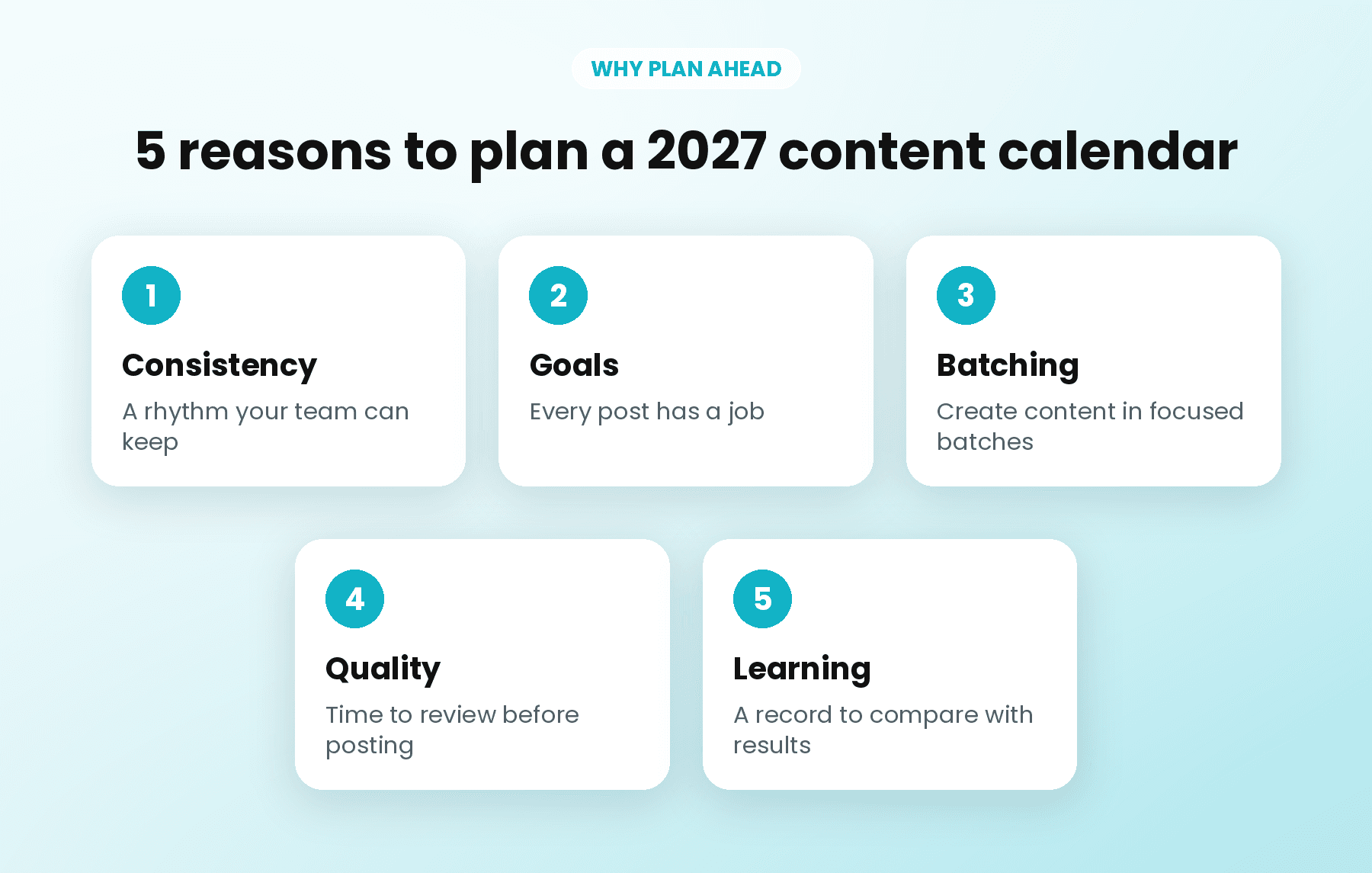
Reason 1: A calendar keeps you consistent
Consistency helps people remember you, and a calendar makes consistency realistic.
When posts depend on spare time, they come in bursts and then go quiet. A calendar sets a rhythm you can keep, whether that's three posts a week or one. People get used to hearing from you, and your team knows exactly what's coming.
Reason 2: It connects your posts to your goals
A calendar turns your marketing goals into specific posts, so each piece of content has a job.
Without a plan, social media becomes a stream of whatever feels urgent. With one, you can see how each month supports a launch, a season, or a goal, such as growing newsletter sign-ups or promoting a new product line. It's also easier to spot gaps, like a month with plenty of promotion but nothing genuinely useful for your audience.
Reason 3: It lets you batch your work
Planning ahead lets you create content in focused batches, which is faster and less draining than making posts one at a time.
Switching between writing, designing, and editing every day takes energy. When you know what's coming, you can write a month of captions in one session and create all the visuals in another. Batching also leaves room for timely posts, because the basics are already done.
Reason 4: It protects your brand's quality
A calendar builds in time to review, so fewer rushed, off-brand, or inaccurate posts go out.
Last-minute posts are where mistakes happen: a wrong date, an outdated price, a logo in the wrong color, or a tone that doesn't sound like you. When posts are planned ahead, there's time to check facts, get approvals, and make sure everything looks and sounds like the same brand.
Reason 5: It helps you learn and improve
A calendar gives you a record of what you posted, so you can compare it with results and plan better next time.
It's hard to learn from posts you can't remember. When your calendar records the pillar, format, and goal of each post, you can review results and see patterns: which topics people saved, which formats they shared, and which days worked best for your audience. That turns your 2027 calendar into a better 2028 calendar.
How do you plan a social media content calendar for 2027?
Review 2026, set a few goals, choose content pillars, map key dates and campaigns, pick a realistic cadence, batch production, and schedule quarterly reviews.
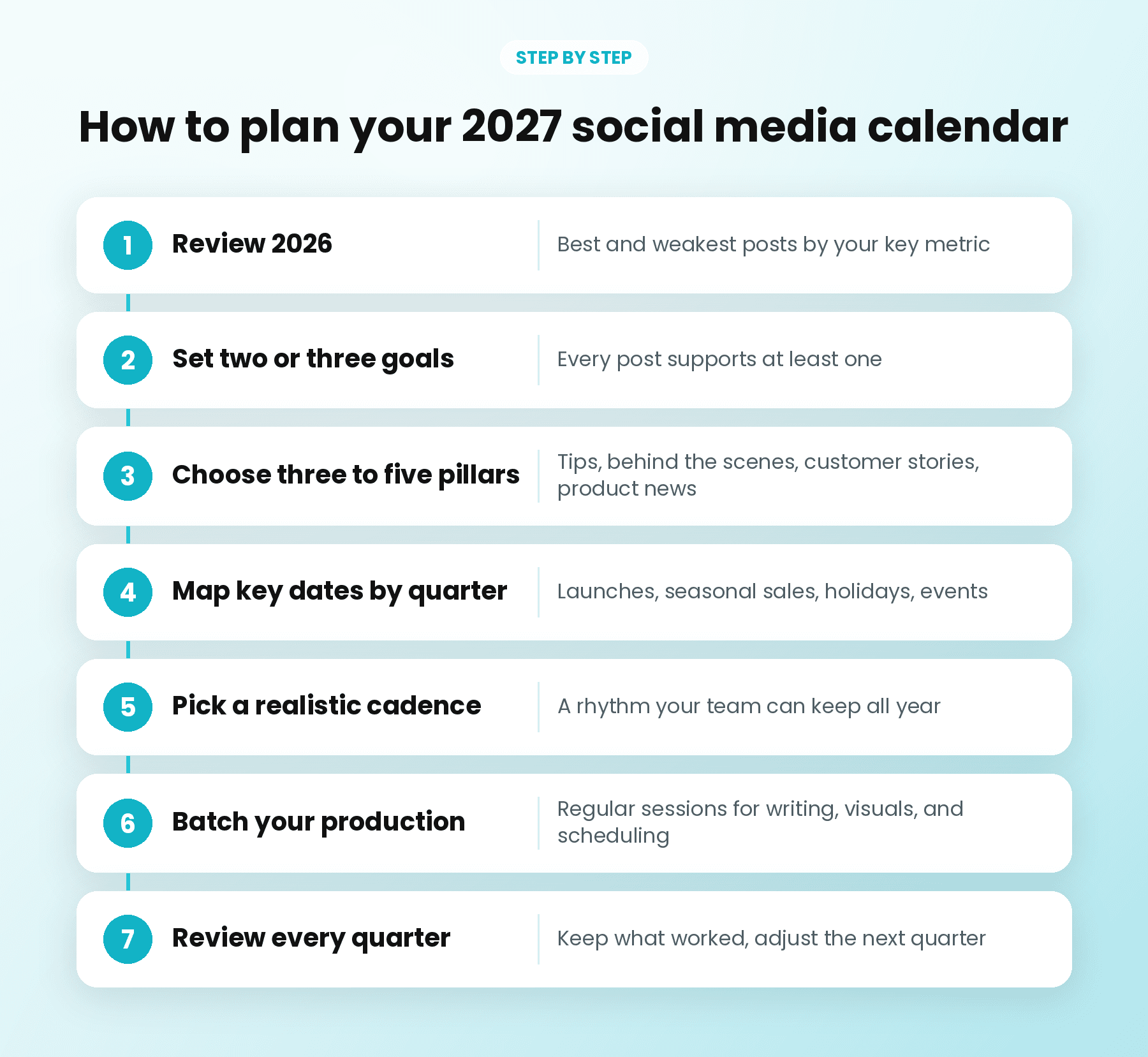
Step 1: Review your 2026 content
List your best and weakest posts by the metric that matters most to you, such as saves, shares, clicks, or enquiries. Note what they have in common, and what you found hardest to sustain.
Step 2: Set two or three goals for 2027
Keep them specific, such as "grow our email list from social" or "promote our new collection each season." Every post should support at least one goal.
Step 3: Choose three to five content pillars
Pillars are recurring themes, such as tips, behind the scenes, customer stories, and product news. They make planning faster and keep your feed balanced.
Step 4: Map key dates and campaigns by quarter
Add the moments that matter to your business and audience: launches, seasonal sales, local holidays, and industry events. Keep it focused. A few well-prepared moments beat a long list of half-finished ones.
| Quarter | Example focus | Planning tip |
|---|---|---|
| Q1 (Jan to Mar) | New year goals, Lunar New Year, fresh starts | Prepare January content in December |
| Q2 (Apr to Jun) | Mid-year launches and seasonal moments | Reuse what worked in Q1 |
| Q3 (Jul to Sep) | Community stories and back-to-routine themes | Start planning your Q4 campaigns |
| Q4 (Oct to Dec) | Year-end sales, gifting, and looking back | Plan your 2028 calendar in November |
Adjust the themes to your market, audience, and the holidays your customers actually celebrate.
Step 5: Pick a cadence you can sustain
Choose a posting rhythm your team can keep up all year, not just in January. It's better to start with fewer posts and add more than to promise daily posts and stop in March. Choose the platforms where your audience actually spends time, and do those well first.
Step 6: Batch your production
Set aside regular sessions for writing, creating visuals, and scheduling. Plan each bigger idea to become several posts, such as a carousel, a short video, and a story.
Step 7: Review every quarter
At the end of each quarter, look at what worked, drop what didn't, and adjust the next quarter's plan. Your calendar should change as you learn.
What should a social media content calendar include?
Include enough detail that anyone on your team can pick up a post and know what to do.
| Column | What it's for |
|---|---|
| Date and time | When the post goes live |
| Platform | Where it's published |
| Pillar | Which theme it supports |
| Goal | What the post should achieve |
| Format | Image, carousel, short video, story, or text |
| Caption and hashtags | The copy, ready to review |
| Visual | A link to the asset or a description of it |
| Call to action | What you want people to do next |
| Owner and status | Who's responsible, and whether it's drafted, approved, or scheduled |
| Results | Key metrics after publishing |
A spreadsheet or a shared board works perfectly well. What matters is that everyone uses the same one.
How Designs.ai can help you fill your 2027 calendar
Planning is the easy part. Producing a steady stream of on-brand posts is where most calendars fall behind. In Agents Mode, you can describe a month's posts in plain language, and specialist agents help create the images, short videos, and slides, with your Brand Kit applied so everything looks like one brand. If you make similar posts every month, Studio lets you save a board with your style references connected to image and video generators, so your posts, stories, and clips stay visually related from January to December.
Common content calendar mistakes to avoid
- Overplanning. A calendar so detailed it can't change will be abandoned.
- Only promoting. Mix in useful, entertaining, and community content.
- Copying the same post everywhere. Adapt the format and caption to each platform.
- Ignoring results. If you never review, the calendar can't improve.
- No buffer. Leave room for timely posts and unexpected news.
Frequently asked questions
What is a social media content calendar?
A social media content calendar is a shared plan that shows what you'll post, on which platforms, and when. It usually includes the format, caption, visual, goal, owner, and status of each post, so your team can plan, create, and review content ahead of time.
Why do I need a social media content calendar?
A content calendar keeps you consistent, connects posts to your goals, lets you batch your work, gives you time to review for quality, and creates a record you can learn from. It replaces last-minute posting with a plan your team can follow.
When should I start planning my 2027 content calendar?
Start in November or December 2026. That gives you time to review this year's results, set goals, and create January content before the holidays, especially with New Year's Day and Lunar New Year arriving within the first six weeks of 2027.
How far ahead should I plan social media content?
Map key campaigns and themes for the whole year at a high level, plan specific posts about a month ahead, and leave room for timely content. Review and adjust the plan every quarter.
How often should I post on social media in 2027?
Post as often as you can maintain good quality all year. A steady, realistic rhythm is better than an ambitious plan you can't keep. Start with a cadence your team can sustain, then increase it if your results and capacity allow.
What should I include in a content calendar?
Include the date and time, platform, content pillar, goal, format, caption, visual, call to action, owner, status, and results. Keep it simple enough that everyone on your team actually uses it.